
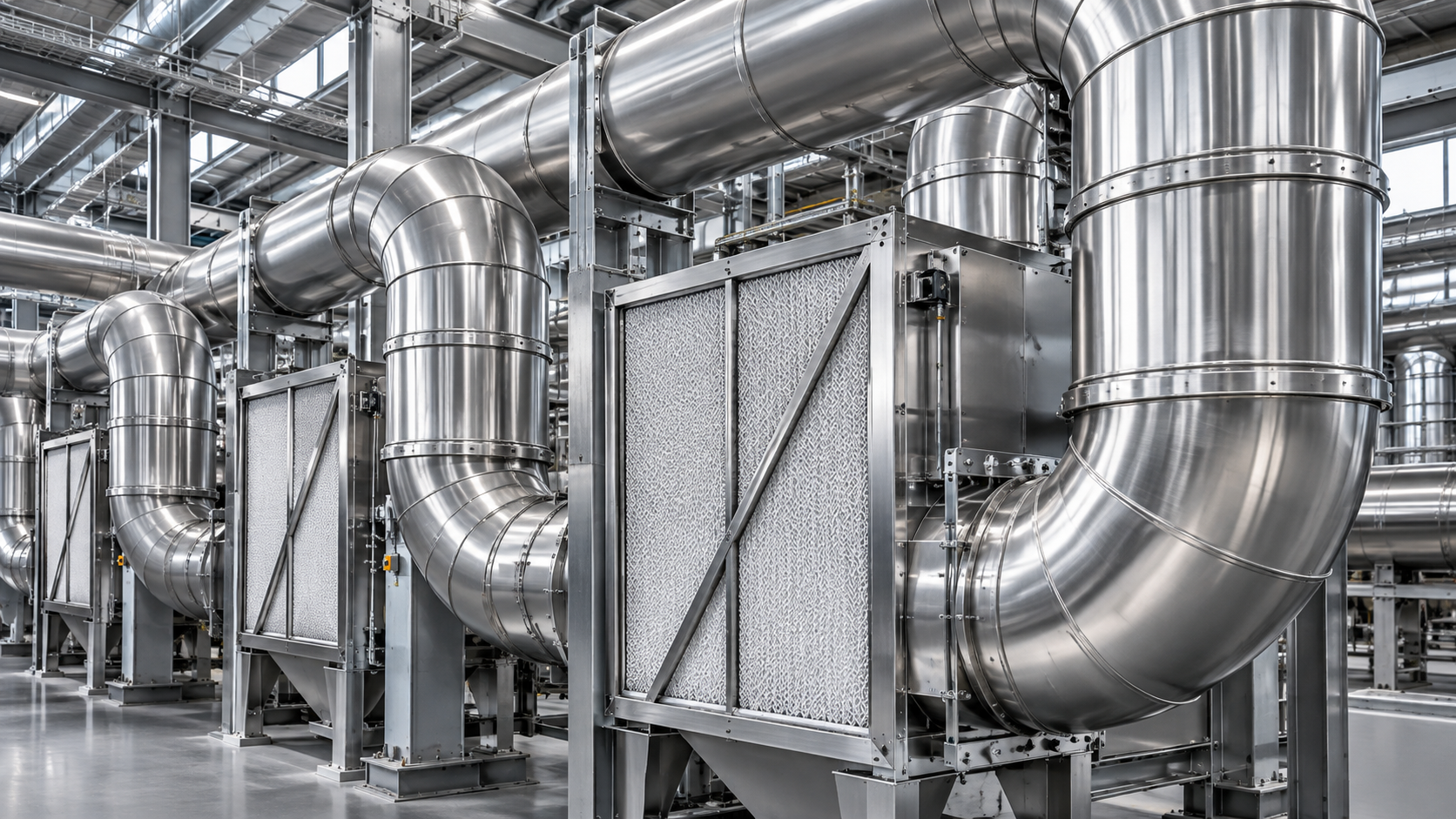
Activated carbon for air and gas streams
CocoCARB captures selected volatile organic compounds, nuisance odors, and gaseous pollutants in ventilation and process-air systems. Its large internal surface area provides adsorption capacity while granular form supports practical airflow through properly designed beds.
Typical air-filtration uses
- Industrial exhaust and odor control
- Commercial HVAC carbon filtration
- Process-gas purification
- Solvent-vapor and VOC reduction
Granular 4 x 8 mesh carbon is listed for air-filtration duties. Contaminant identity, concentration, humidity, temperature, residence time, and pressure drop affect performance.
Design considerations for carbon air filters
Activated carbon selection should begin with a clear contaminant profile. Some gases require specially impregnated media rather than standard activated carbon, so application details must be reviewed before quotation.
Filter life depends on carbon mass, airflow, inlet concentration, competing compounds, humidity, and the required outlet limit. Site testing and a defined replacement schedule support dependable operation.
Complete application guide
Air Filtration activated carbon: performance, selection, and use
Activated carbon air filtration is used when gaseous molecules, vapors, or odors must be captured from an air stream. Unlike particulate filters, which trap dust by physical interception, carbon media adsorb selected contaminants onto a very large internal surface. Applications range from commercial odor control to industrial exhaust polishing and process-gas purification. Coconut-shell granular carbon offers high surface area and mechanical strength, but the correct media depends on the contaminant. Some acid gases, alkaline gases, or low-boiling compounds require impregnated or specialty media rather than standard activated carbon.
Contaminant molecules move from the bulk air stream through an external film and into the carbon pores, where adsorption forces retain them. Capacity is influenced by molecular properties, concentration, temperature, relative humidity, competing vapors, and residence time. High humidity can occupy pore space or reduce capacity for some organics. Temperature increases may promote desorption. A bed that performs well for a concentrated organic vapor may behave differently at very low concentrations, so design data should match the expected service condition.
Typical applications and evaluation scenarios
- Industrial VOC emission polishing
- Commercial HVAC odor control
- Wastewater plant odor treatment
- Process-gas purification
- Solvent vapor adsorption
- Protective carbon filter beds
How to select activated carbon for air filtration
Selection priorities
Selection begins with a complete gas profile rather than the word odor alone. Identify target compounds, concentration ranges, peak events, airflow, temperature, humidity, dust loading, required outlet level, and safety classification. Granule size affects pressure drop and contact efficiency. The listed 4 x 8 mesh air-filtration form supports practical airflow in appropriately designed beds, but vessel depth and superficial velocity remain critical. Compatibility, heat of adsorption, ignition risk, and the possibility of polymerizing or reactive contaminants should be reviewed by qualified personnel.
System and process design
A carbon filter needs uniform airflow through the full bed. Bypass gaps, shallow packing, settling, or poor retainers can shorten effective life even when the media has unused capacity. Designers should provide suitable prefiltration for dust and aerosols, access for loading and removal, pressure measurement, safe isolation, and a sampling plan. Bed depth is usually more meaningful than simply specifying a thin carbon panel. For critical duties, duty-standby or lead-lag vessels can provide redundancy and a clearer breakthrough signal.
Operation, monitoring, and performance review
What to monitor
Monitoring options include direct measurement of target compounds, total VOC instruments, odor panels where appropriate, differential pressure, temperature, and periodic media sampling. Odor perception alone is unreliable because people adapt and have different thresholds. Replacement should be planned from measured breakthrough, validated service-life calculations, or a conservative schedule. Sudden concentration or temperature changes should trigger review because they can consume capacity faster than historical averages suggest.
Important limitations
Standard activated carbon does not efficiently remove every gas. Carbon monoxide, many light inorganic gases, and some highly volatile compounds may require catalysts, impregnated media, thermal treatment, scrubbing, or another control technology. Adsorbed organics can create heat and fire hazards under certain conditions. Used media may also be hazardous because of the captured chemicals. Engineering review, material compatibility, grounding, fire prevention, and compliant disposal or regeneration procedures are essential parts of a safe installation.
Qualification and supply
Testing, documentation, and commercial planning
Start with representative testing
A product data sheet is a screening tool, not a guarantee of performance in every system. Use representative feed, realistic concentrations, expected contact time, operating temperature, and the actual acceptance method whenever possible. Compare the proposed carbon with a known baseline and document the preparation, dosage, sampling, and analytical procedure. Where a laboratory test cannot reproduce hydraulic or mechanical conditions, follow it with a controlled site trial and agreed monitoring plan.
Review quality documents
Technical Data Sheets summarize typical properties, while Certificates of Analysis report selected results for a supplied batch. Safety Data Sheets support workplace handling and emergency planning. Customers may also need country-of-origin information, product samples, test methods, retained samples, or a customized specification. Document requirements should be discussed before ordering because not every certificate or test is automatically included with every grade or shipment.
Prepare a complete inquiry
State the intended air filtration duty, current material, target performance, relevant process conditions, preferred particle size or form, required quantity, packaging, delivery destination, and schedule. Include mandatory specification limits and analytical methods. A complete inquiry helps the supplier identify whether a standard CocoCARB grade is appropriate, whether additional testing is needed, and what commercial and logistical information belongs in the quotation.
Packaging, storage, handling, and responsible use
Packaging and storage
CocoCARB is available in 25 kg sacks for samples, trials, routine handling, and smaller requirements, plus 550 kg bulk bags for larger industrial supply. Packaging choice should match lifting equipment, storage space, contamination controls, and consumption rate. Store unopened material in a dry, covered, well-ventilated area away from incompatible chemicals, ignition sources, and substances that could be adsorbed from the surrounding environment. Rotate stock and protect packaging from puncture, water, and direct weather exposure.
Opened packages should be resealed or transferred into a suitable labeled container. Activated carbon can adsorb vapors during storage, so proximity to fuels, solvents, fragrances, pesticides, or process chemicals can change the material before use. Customers with strict purity requirements should define dedicated storage and handling controls.
Safe and responsible handling
Review the current Safety Data Sheet before receiving or using the product. Control dust during opening, transfer, mixing, loading, and cleanup. Use suitable ventilation, grounded equipment where required, housekeeping methods that avoid dispersing dust, and personal protective equipment selected through the site’s risk assessment. Wet activated carbon can reduce oxygen in enclosed spaces, so confined-space hazards and ventilation must be addressed by qualified personnel.
Spent carbon may contain concentrated process contaminants and should never be assumed non-hazardous. Characterization, transport, regeneration, recycling, or disposal must follow the captured substances, local requirements, and the customer’s environmental procedures. Technical and commercial guidance from the supplier does not replace professional engineering, safety, regulatory, or environmental review.
Implementation roadmap
From initial inquiry to routine operation
1. Define the duty and baseline
Begin with a written description of the problem, the existing process, and the result that must be improved or maintained. Record current media, operating conditions, consumption, maintenance frequency, analytical results, failure modes, and total cost. A baseline prevents a trial from being judged only by impressions. It also helps the supplier understand whether the request concerns adsorption capacity, kinetics, mechanical strength, purity, pressure drop, appearance, documentation, logistics, or several factors at once.
Representative samples and complete operating data are more valuable than a product name alone. Include normal conditions as well as startup, peak loading, seasonal changes, upset conditions, and shutdown practices. Define who will approve the technical specification, who will operate the trial, who will review safety, and who will authorize commercial supply.
2. Screen, test, and trial
Use published specifications to identify plausible candidates, then apply a test method connected to the real duty. A fair comparison uses the same sample preparation, dosage, contact time, temperature, analytical method, and endpoint for every candidate. Record raw data and observations, including filtration behavior, dust, wetting, pressure, color, odor, particle damage, or any unexpected interaction with the process.
If laboratory work is promising, plan a controlled site trial with a written start date, quantity, sampling schedule, operating window, acceptance criteria, and stop conditions. Keep unrelated process changes to a minimum. Trial duration should be long enough to observe stable operation and relevant lifecycle effects rather than only initial fresh-carbon performance.
3. Approve and control supply
After technical acceptance, convert the important requirements into a purchasing specification. Identify the product, grade, test methods, limits, packaging, labeling, documents, sampling rights, handling requirements, delivery terms, and process for reviewing changes or nonconforming material. Distinguish mandatory acceptance limits from typical informational values so both parties understand what controls release.
Routine supply should include lot traceability and an agreed document flow. Receiving teams need a practical inspection process for packaging condition, labels, quantity, and required certificates. Store and issue material by lot where traceability matters, and retain records that connect incoming carbon with process performance.
Evaluating suppliers and total lifecycle value
Look beyond the purchase price per kilogram
The lowest unit price may not produce the lowest operating cost. Evaluation can include adsorption capacity, service life, carbon or media consumption, product loss, pressure drop, downtime, labor, waste handling, regeneration, energy, cleaning, analytical work, freight, inventory, and the consequences of unstable performance. The relevant cost model differs by application, but it should reflect the full period from receiving through use and final management of spent material.
Consistency also has economic value. A material that performs predictably allows more stable operating targets, clearer replacement planning, and faster investigation when another part of the process changes. When comparing offers, confirm whether specifications are typical or guaranteed, which tests are performed per batch, and whether packaging and documentation are included.
Build a practical supplier relationship
A useful supplier should ask enough questions to understand the duty, state what is and is not confirmed, provide traceable documents, and avoid promising performance that has not been tested. Buyers should communicate forecasts, delivery constraints, approval steps, and changes in operating conditions. Early communication is especially important for customized specifications, nonstandard mesh sizes, special packaging, export documentation, or large project quantities.
Periodic review can cover quality trends, delivery performance, complaints, corrective actions, forecast accuracy, documentation, and opportunities to improve packaging or inventory. If a process or specification changes, repeat the appropriate level of technical assessment. Long-term supply works best when commercial continuity and application performance are managed together rather than treated as separate conversations.
Troubleshooting, change control, and continuous improvement
Investigate performance changes systematically
When results move outside the expected range, confirm the data before assigning a cause. Review sampling location, sample preservation, instrument calibration, analytical method, calculations, and whether the observation represents a sustained trend or a single event. Compare the affected period with feed composition, flow, temperature, pressure, pH, humidity, equipment condition, maintenance, operator actions, upstream treatment, and any change in carbon lot or storage history.
Inspect the physical system for bypass, channeling, damaged screens or retainers, leaks, abnormal pressure drop, settling, dust, carryover, poor mixing, and incorrect loading. Check receiving and usage records to verify product identity and lot traceability. Preserve representative samples of unused and used material where practical. A structured investigation keeps the team from replacing carbon prematurely when the root cause is elsewhere, or overlooking a material issue when the process appears normal.
Control changes and retain learning
Changes to grade, supplier, particle size, specification, packaging, dosage, vessel configuration, operating window, analytical method, or replacement interval should follow the customer’s management-of-change procedure. Define the reason, technical risk, trial plan, approval authority, documentation, training, and rollback criteria before implementation. Critical applications may require formal requalification even when the proposed change appears minor.
After implementation, compare results with the agreed baseline and record both benefits and unintended effects. Update operating procedures, purchasing specifications, inspection plans, safety assessments, inventory settings, and training materials when the evidence supports a permanent change. Share relevant findings with the supplier so future batches, documents, packaging, or technical discussions can improve. Continuous improvement depends on traceable evidence, not memory, and makes each future carbon evaluation faster and more reliable.
Application FAQ
Frequently asked questions
What pollutants can activated carbon air filters remove?
Activated carbon can adsorb many organic vapors, VOCs, and odor-causing compounds. Performance varies significantly by molecule, concentration, humidity, temperature, and contact time. Some inorganic gases and highly volatile compounds require impregnated carbon, catalysts, scrubbing, or another control technology.
Is standard activated carbon suitable for every odor?
No. Odor is a sensory description, not a contaminant identification. The responsible compounds should be identified where possible. Hydrogen sulfide, ammonia, acid gases, and other difficult compounds may need specially impregnated media and a system designed for the actual concentration and airflow.
How does humidity affect carbon air filtration?
Water vapor can compete for pore space and reduce capacity for some organic compounds. Condensation can also disturb airflow and media performance. Relative humidity, temperature, and dew-point conditions should be included in the design data and reflected in service-life expectations.
What determines the life of an activated carbon filter?
Life depends on carbon mass, bed depth, airflow, inlet concentration, peak events, contaminant properties, humidity, temperature, and the acceptable outlet level. Measured breakthrough or a validated conservative replacement schedule is more dependable than judging by odor alone.
Why is bed depth important in a carbon filter?
A sufficient bed provides residence time and a working adsorption zone. Very thin panels may have limited capacity and can allow early breakthrough. Uniform packing, retainers, seals, prefiltration, and prevention of bypass are as important as the nominal carbon quantity.
Can activated carbon create a fire risk?
Certain adsorbed organics, high concentrations, reactive compounds, poor heat removal, or inappropriate handling can create heat and fire hazards. Qualified engineering review should address temperature monitoring, grounding, ignition control, compatibility, isolation, and emergency procedures for the specific duty.
What information is needed for an air-filtration quotation?
Identify target compounds, normal and peak concentrations, airflow, temperature, humidity, dust or aerosol loading, required outlet, vessel or filter dimensions, current media, quantity, packaging, destination, and any hazardous-area or materials-compatibility requirements.
How should spent air-filtration carbon be managed?
Spent media can release or concentrate captured chemicals and may be hazardous. Characterization, safe removal, sealed packaging, transport, regeneration, and disposal should be based on the adsorbed compounds, Safety Data Sheets, site procedures, and applicable environmental regulations.