
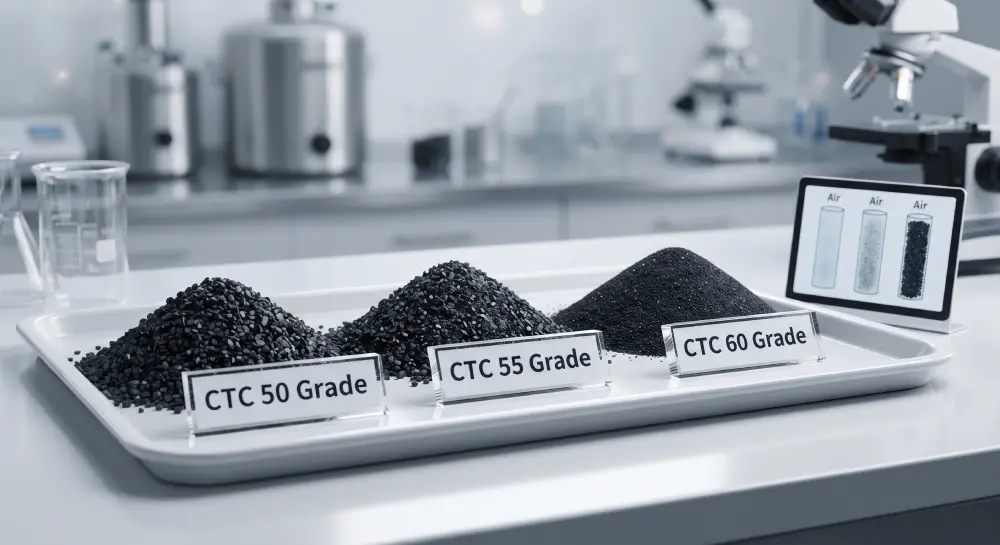
CTC 50, CTC 55, and CTC 60 activated carbon grades provide buyers with increasing activity levels under a standardized carbon tetrachloride test. The grades can be useful starting points when comparing coconut-shell activated carbon for gold recovery, but the CTC value should never be the only selection criterion. Plant performance also depends on hardness, particle size, ash, moisture, apparent density, pore accessibility, regeneration, and operating conditions.
What a CTC activity number means
CTC activity measures the amount of carbon tetrachloride vapor adsorbed under specified laboratory conditions and expresses the result relative to the carbon sample. It is an established indicator of pore development. A higher value generally indicates greater activity in that test, but gold adsorption occurs in an aqueous cyanide system with different molecules and competing effects.
For that reason, CTC activity is best used as one part of a specification package. Gold-loading kinetics, equilibrium loading, hardness, size distribution, and plant results provide additional evidence.
CocoCARB CTC 50
CTC 50 is positioned as a dependable standard activity grade for established gold-recovery duties. It may be considered where the operation values a balanced combination of adsorption performance, hard coconut-shell granules, controlled sizing, and commercial efficiency.
A plant should still confirm suitability through representative testing. Standard activity does not mean every ore, solution, residence time, or regeneration system will produce the same result.
CocoCARB CTC 55
CTC 55 provides an intermediate activity level for operations seeking additional adsorption capability while retaining the physical advantages associated with coconut-shell granular carbon. It can be included in comparative laboratory tests or a plant trial when CTC 50 and CTC 60 represent the lower and upper options.
Intermediate grades can be valuable because total value is not always linear with activity. The right balance may depend on loading rate, carbon losses, regeneration response, supply cost, and the plant’s ability to use the additional activity.
CocoCARB CTC 60
CTC 60 is the high-activity option in the listed range and is intended for demanding adsorption duties. It may be evaluated where faster kinetics, higher activity, or difficult solution conditions justify comparison with standard grades.
High activity should be assessed together with hardness and operating behavior. A grade that performs strongly in a laboratory test but generates unacceptable losses, screens poorly, or responds inconsistently to regeneration may not provide the best whole-of-circuit result.
Side-by-side properties to review
- CTC activity: an indicator of pore development under the referenced vapor-phase method.
- Iodine number: another common measure associated with micropore capacity.
- Hardness: resistance to mechanical breakdown under the test method.
- Ash and moisture: useful for comparing mineral residue and received condition.
- Apparent density: relevant to volumetric inventory and handling calculations.
- Mesh distribution: important for screening, transfer, hydraulics, and kinetics.
- Gold-loading behavior: application-specific evidence under representative solution conditions.
- Regeneration response: activity and strength after repeated use and thermal treatment.
Why the highest grade is not automatically the best
A plant with sufficient residence time and a stable circuit may achieve its objectives with CTC 50. Another operation may benefit from CTC 55 or CTC 60 because of shorter contact time, changing solution chemistry, higher throughput, or a stricter barren-solution target. The economics should include carbon purchase cost, inventory, make-up rate, gold loading, carbon losses, elution frequency, regeneration, and operational stability.
Design a grade-comparison trial
Use representative samples, consistent preparation, agreed test methods, and clear acceptance criteria. Where possible, compare products under the same solution, carbon concentration, contact time, temperature, and analytical procedure. For a plant trial, record baseline performance and avoid unrelated process changes.
Track both fresh and regenerated carbon. A high-activity fresh sample may behave differently after plant exposure and regeneration, so lifecycle performance matters.
Requesting a grade quotation
Tell the supplier your process configuration, current grade, confirmed mesh requirement, typical carbon inventory, consumption, trial quantity, routine order volume, packaging preference, destination, target date, and required documents. CocoCARB grades are listed with 6 x 12 mesh for gold recovery; other sizes must be confirmed.
Compare the detailed CocoCARB product pages or send a product inquiry to discuss CTC 50, CTC 55, and CTC 60 activated carbon for your operation.