
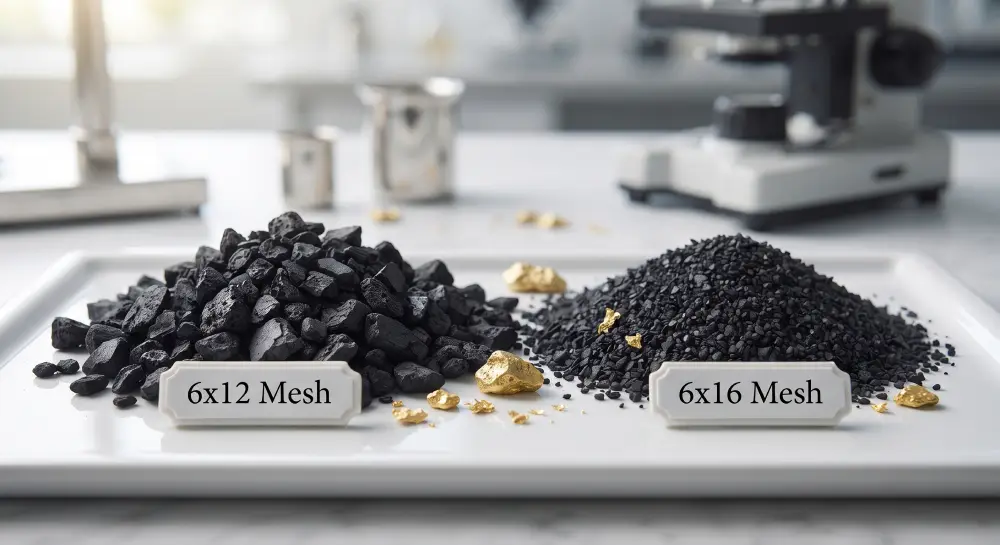
Gold recovery carbon mesh size affects screening, hydraulic behavior, carbon transfer, adsorption kinetics, and the risk of physical losses. Buyers commonly encounter 6 x 12 mesh and may also request 6 x 16 mesh. These descriptions identify sieve-size ranges, but they should be tied to a defined test method and an actual particle-size distribution rather than treated as labels alone.
What mesh size describes
Mesh numbers refer to standardized sieves. A lower mesh number corresponds to a larger opening, while a higher number corresponds to a smaller opening. A 6 x 12 mesh product is intended to fall between the relevant No. 6 and No. 12 sieve limits, subject to the product specification and allowed oversize or undersize.
A 6 x 16 mesh request extends the lower end toward smaller particles. That difference can affect the percentage retained by plant screens, carbon movement, surface-area accessibility, and pressure drop. Exact distributions vary, so buyers should request the specification and test method.
Why particle size matters in CIP and CIL
Interstage screens must retain activated carbon while allowing slurry to pass. If too much material is smaller than the screen aperture, carbon and loaded gold may be lost. If particles are excessively coarse, mass transfer may be slower because dissolved gold must diffuse farther into the granule.
Carbon transfer equipment, pumps, eductors, pipelines, screens, and regeneration systems also interact with particle size. Wear can gradually shift the distribution toward smaller particles. Routine sieve analysis helps operators distinguish incoming product sizing from degradation inside the circuit.
Confirmed CocoCARB sizing
CocoCARB’s listed CTC 50, CTC 55, and CTC 60 gold-recovery grades use a confirmed 6 x 12 mesh specification. This is the size that should be used when reading the current product information or requesting a standard quotation.
If an operation requires gold recovery carbon in 6 x 16 mesh, the request should be stated clearly and availability should be confirmed before purchase. The website does not present 6 x 16 mesh as a standard available CocoCARB grade. This distinction protects buyers from relying on an unverified assumption.
Coarser versus finer granules
Potential advantages of coarser retention
Coarser particles may be easier to retain on screens and may provide greater resistance to loss if the circuit has challenging screening conditions. They can also influence transfer and settling behavior.
Potential advantages of a finer distribution
Smaller particles provide shorter diffusion paths and may show faster apparent adsorption under some conditions. However, they can increase screen-retention demands, pressure drop in columns, dust, and vulnerability to loss if not properly controlled.
Neither direction is universally better. The correct distribution is the one that aligns with the plant’s screen apertures, hydraulics, contact time, equipment, and performance objectives.
How to evaluate a mesh-size change
Document the existing product distribution, screen apertures, screen condition, carbon losses, inventory, advance rate, loading, and recovery. Use laboratory sieve analysis with agreed methods. If trialing a new size, establish baseline data and monitor oversize, on-size, undersize, transfer behavior, fines, and gold losses.
A size change can alter more than adsorption. It may affect pump loading, screen blinding, column pressure drop, settling, dewatering, kiln behavior, and housekeeping. Engineering and operating teams should review the full circuit.
Questions to ask a supplier
- What is the nominal mesh designation and referenced sieve standard?
- What oversize and undersize limits apply?
- Is the distribution typical or guaranteed?
- Which sampling and sieve-analysis methods are used?
- Does the quoted grade match the requested CTC activity and hardness?
- Is the requested mesh a standard product or a custom requirement?
- What sample quantity is available for qualification?
- Which batch and shipping documents can be supplied?
Particle size is only one selection factor
Mesh should be reviewed alongside adsorption activity, iodine number, hardness, ash, moisture, apparent density, gold-loading kinetics, regeneration response, and commercial supply. A tightly controlled distribution cannot compensate for poor adsorption or severe attrition, just as high activity cannot compensate for a size that the plant cannot retain.
Request the correct product
When contacting Richson’s Trading, specify whether the inquiry is for the confirmed 6 x 12 mesh CocoCARB gold-recovery grade or a separate 6 x 16 mesh requirement that needs availability confirmation. Include the CTC grade, quantity, packaging, delivery destination, schedule, and documents needed. Visit the product specifications or send a detailed inquiry.