
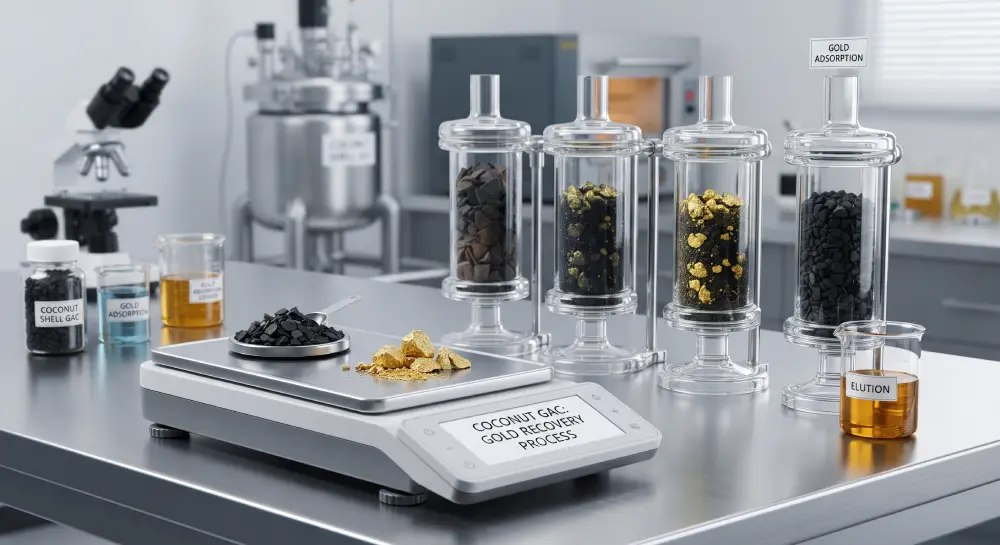
Coconut shell granular activated carbon for gold recovery is valued for a useful combination of internal pore structure and physical strength. In a gold plant, carbon must do more than adsorb: it must survive transfer, screening, acid washing, elution, thermal regeneration, quenching, and repeated return to service. Coconut-shell carbon is frequently evaluated because its dense raw material can support durable granules after controlled manufacture.
From coconut shell to activated carbon
Production begins with selected coconut shells that are carbonized to remove volatile components and create a carbon-rich char. Steam activation then develops a network of internal pores. The material is sized, cleaned, tested, and packed according to the intended product specification.
Activation conditions must balance pore development and yield. Excessive burn-off may increase some activity measures while weakening the granule. Insufficient activation may preserve strength but limit adsorption. Consistent manufacturing aims to achieve the required activity without sacrificing the physical properties needed in service.
Micropores and gold adsorption
Activated carbon contains pores of different sizes. Coconut-shell carbon is known for a strongly microporous structure, providing a large internal surface. Gold-cyanide complexes move from solution to that surface during adsorption. Actual loading depends on pore accessibility, solution chemistry, carbon condition, contact time, temperature, competing metals, organic foulants, and other process variables.
CTC activity and iodine number are common characterization tests, but they should not be treated as direct guarantees of gold recovery. Application-specific laboratory testing and plant trials provide stronger evidence.
Hardness, attrition, and carbon losses
Granular activated carbon travels through demanding equipment. Abrasion can generate smaller particles and fines that pass through interstage screens or become difficult to recover. Because loaded fines may contain gold, physical losses can become financial losses.
High hardness helps, but plant practices are equally important. Damaged pumps, excessive transfer velocity, worn screens, harsh kiln discharge, thermal shock, poor quenching, and rough handling can break even a strong carbon. Carbon-loss investigations should examine the whole circuit.
Particle size and screening
A narrow, controlled size distribution supports predictable screening and movement. Coarser granules can be easier to retain but may have longer diffusion paths; finer granules may adsorb faster but challenge screen retention and hydraulics. The correct balance depends on the circuit.
CocoCARB’s published gold-recovery grades use 6 x 12 mesh. A request for 6 x 16 mesh or another distribution should be clearly stated and confirmed before quotation. Never assume that a named mesh size is interchangeable across suppliers without reviewing the actual test method and distribution limits.
Fresh versus regenerated carbon
Fresh carbon enters service with its manufactured pore structure. During operation, organic compounds, inorganic scale, fine solids, and process contaminants may block pores or coat the surface. Acid washing can remove selected inorganic deposits, while thermal regeneration is used to restore adsorption capacity by removing or transforming foulants.
Regeneration conditions influence both activity and durability. Temperature, residence time, atmosphere, feed moisture, kiln loading, discharge, and quenching should be controlled. Monitoring fresh and regenerated carbon helps distinguish product behavior from regeneration problems.
Storage and handling
Activated carbon should be stored in a clean, dry area, protected from contamination, moisture, odors, chemicals, and damaged packaging. During transfer, control dust and follow the Safety Data Sheet. Good lot identification supports traceability and meaningful comparison of test results.
How to qualify a coconut-shell carbon
Start with the process objective and current baseline. Compare activity, iodine number, hardness, ash, moisture, apparent density, mesh distribution, packaging, and documentation. Conduct laboratory adsorption and attrition work where appropriate, followed by a plant trial with defined sampling and acceptance criteria.
The goal is not to prove that coconut shell is universally superior to every alternative. The goal is to confirm that a specific product delivers the required adsorption, durability, handling, and commercial value in the customer’s circuit.
Philippine supply and product options
CocoCARB is produced from Philippine coconut-shell raw material and supplied by Richson’s Trading for local and export requirements. Available product discussions include CTC 50, CTC 55, and CTC 60 grades, 25 kg sacks, 550 kg bulk bags, product samples, and supporting technical documents. Review the product range or request a quotation with your process and delivery details.