
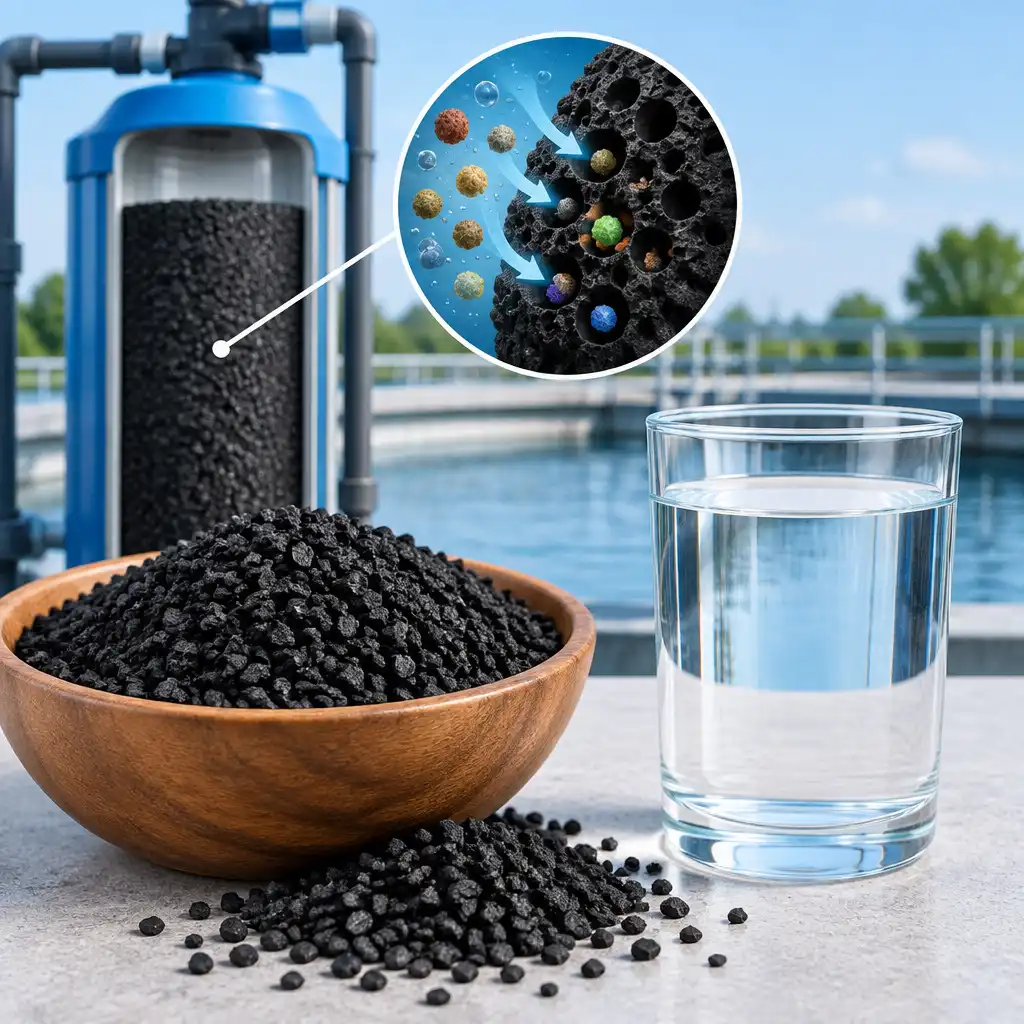
Activated carbon for water treatment is used when a process must reduce compounds that affect taste, odor, color, product quality, or downstream equipment. It can support municipal, commercial, and industrial treatment systems, but the correct carbon cannot be selected from one specification alone. The best choice depends on the compounds to be removed, water chemistry, contact time, hydraulic conditions, replacement strategy, and required documentation.
For Philippine facilities, a useful evaluation starts with the treatment objective. Operators should identify whether the priority is dechlorination, odor control, removal of dissolved organic compounds, polishing after another treatment stage, or protection of sensitive downstream processes. This defines the tests and operating data needed before a final grade is approved.
How activated carbon works in water treatment
Activated carbon has a highly developed internal pore structure. Dissolved organic molecules can move from the water into these pores and adsorb onto the internal surface. Coconut-shell activated carbon is commonly considered where high hardness, a predominantly microporous structure, and resistance to handling are important.
Adsorption is influenced by molecular size, concentration, temperature, pH, competing compounds, and contact time. A laboratory result can help screen products, but it does not replace evaluation under representative operating conditions.
Start with the contaminant and treatment goal
Before comparing carbon grades, document the incoming water quality and the required outlet condition. Useful information includes the target compounds, concentration range, flow rate, temperature, pH, suspended solids, organic loading, and any oxidants or competing contaminants.
The treatment objective should also be measurable. Instead of requesting a carbon for “cleaner water,” define the parameter to be controlled and the acceptance limit. This makes supplier comparisons more useful and creates a clear basis for pilot testing.
Specifications buyers should compare
Common purchasing data include iodine number or another activity indicator, moisture, ash, apparent density, particle size, hardness, and product origin. These values help describe a carbon, but they should be interpreted together.
Particle size affects pressure drop, kinetics, and backwashing behavior. Hardness matters because excessive breakage can create fines and increase carbon loss. Apparent density affects bed volume and the mass of media required. Ash and extractables may matter when water purity or downstream sensitivity is critical.
For granular systems, buyers should also confirm the vessel design, bed depth, empty-bed contact time, flow direction, distributor condition, and backwash procedure. Powdered activated carbon requires a different evaluation because dosage, mixing, settling, and solids removal become central to performance.
Qualification and pilot testing
A controlled trial is the most reliable way to compare candidate carbons. Establish baseline water data, use consistent operating conditions, and measure the target parameter at defined intervals. Track pressure drop, backwash frequency, fines, and carbon consumption as well as treatment performance.
The lowest purchase price per kilogram may not deliver the lowest treatment cost. Service life, usable capacity, labor, waste handling, product losses, and operational interruptions all affect the total cost of ownership.
Philippine supply and documentation
When sourcing coconut shell activated carbon in the Philippines, confirm available packaging, lead time, batch documentation, storage requirements, and delivery location. Ask for a technical data sheet, safety information, certificate availability, and a representative sample when qualification is required.
CocoCARB offers Philippine-origin coconut-shell carbon options and practical product guidance. Review the water-treatment application and available CocoCARB grades before requesting a quotation. Facilities also evaluating vapor or odor control can read the activated carbon for air filtration guide.
Request a water-treatment quotation
To receive a relevant recommendation, include the water source, target compounds, flow rate, current treatment train, vessel or dosing method, preferred particle size, required quantity, delivery location, and qualification documents. Contact Richson’s Trading to discuss samples, technical data, and supply options.